
Planning for Our Future Water Supply
The Abbotsford Mission Water Sewer Commission oversees the regional water system that supplies water to the City of Mission and the City of Abbotsford. As the co-owner and Operator of the regional water system, the City of Abbotsford is in the early stages of developing a New Water Source for our two communities.
Today, our regional water system relies on three main sources: Norrish Creek north-east of Mission, Cannell Lake in Mission, and wells in Abbotsford. The Norrish Creek Watershed is the primary source for the supply of drinking water to the regional water supply system, providing approximately 60 to 70% of the water supply for Abbotsford and Mission annually.
Supporting community growth and development requires that drinking water be reliably available over the long-term, efficiently delivered when and where it is needed, and used wisely. Reliability requires addressing both current and potential future challenges, such as the potential impacts of climate change.
New Water Source Project
The Abbotsford Mission Water Master Plan identifies new vertical wells to be located in Matsqui Prairie as the preferred long-term option for augmenting Abbotsford and Mission’s water supply capacity and resilience, subject to further study. The New Water Source Project is in the initial stages of studying this new water source to improve the regional system’s ability to deliver safe and reliable drinking water to the community at a reasonable cost.
The New Water Source Project technical team recently completed their background research and are now moving into the Stage 2 – Field Investigations phase of the project. The purpose of the field investigations is to help determine whether vertical wells located in Matsqui Prairie will be able to reliably meet long-term water supply needs and, if so, to identify the optimal number and locations for the wells.
To help establish this, the initial field investigations starting in May 2026 will focus on evaluating subsurface conditions on City-owned property in Matsqui Prairie utilizing data collection methods conducted by field crews on foot and by boat along the Fraser River. During this period, field crews, survey equipment, vehicles and a small survey vessel will be intermittently operating in the Matsqui Prairie area and along the Fraser River. Once this work is complete and findings are reviewed, additional field investigations, including test drilling, will take place over the summer and fall of 2026.
Community Engagement and Feedback
Abbotsford and Mission are growing communities, and we are working to ensure that everyone continues to have safe, reliable drinking water, now and in the future. Community engagement and input is an important part of the New Water Source Project and all feedback from the public will be taken into consideration.
The City of Abbotsford is committed to keeping residents informed and engaged as the project progresses. For the latest updates and future engagement opportunities, sign up under “Follow Project” (click the button at the top of the page) to receive key information as the discovery phase moves forward through 2026 and 2027.
Project Updates
October 9, 2026
Following the investigative drilling and installation of monitoring wells completed along the Matsqui Trail, two pumping wells are now being installed at City-owned sites in Matsqui Prairie, as shown on the map below.
Beginning in mid-October, Field Drilling Contractors Ltd. will drill and install two test pumping wells, one near each end of the study area. During drilling, crews will briefly test how much water can be produced from different layers of sand and gravel. This will help identify the most productive depths for each well. Well installation is estimated to take three to four weeks.
Stó:lo Research and Resource Management Centre will be on site throughout drilling to monitor the soil brought to the surface and, if archaeological material is identified, help ensure it is appropriately protected.
Once the first pumping well is installed, Precision Service and Pumps Inc. will conduct a pumping test to measure water levels and water quality in the well and nearby monitoring wells. The same process will be repeated after the second pumping well is installed. This information will help the project team better understand and assess whether vertical wells could reliably meet the community’s long-term water needs.
This stage of field investigation is expected to be completed mid-December 2026.
What is test pumping?
Test pumping involves two stages. First, a short test of approximately one day, where the pumping rate is gradually increased, followed by a longer test, during which water is pumped at a steady rate for approximately 10 days without stopping. The tests will help determine how much water each well can produce and how the groundwater system responds to pumping.
Pumping will run 24 hours a day, 7 days a week, powered by a diesel generator equipped with silencers. Noise levels are expected to be similar to regular traffic noise, and given the location of the wells, are not expected to significantly impact nearby residences.
Trail and dike access
Matsqui Trail and dike access will remain open at all times. Trail users may notice a well drilling rig, equipment, work trucks, and signage near work areas. The drilling site will be cordoned off with plastic fencing.
Drilling remains limited to weekdays from 7 a.m. to 5 p.m. Test pumping will run continuously, but crews will only be on site periodically outside those hours.
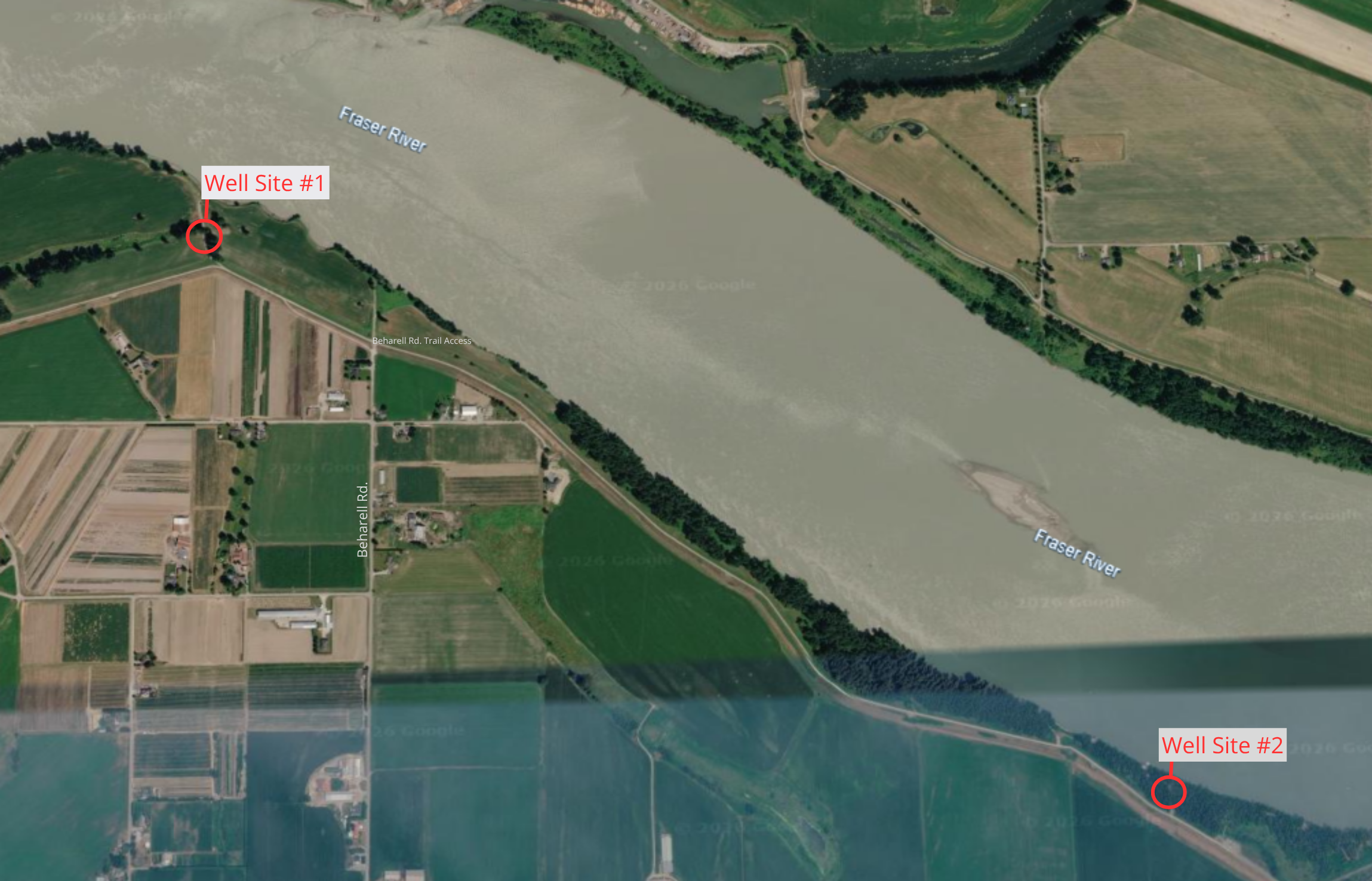
Pumping well locations
August 5, 2026
Over the next few months, crews from Peter’s Well Drilling and Blue Max Sonic Drilling will be conducting investigative drilling at several City-owned sites in Matsqui Prairie as part of Stage 2 Field Investigation work for our New Water Source Project.
Before drilling begins, the Stó:lō Research and Resource Manage Centre will be on-site to complete archaeological test pits at the planned drill site locations. This work will be carried out using shovels and hand augers to help identify and protect any potential archaeological resources. If no artifacts are found, the test pits will be backfilled the same day. If a test pit needs to remain open for further assessment, the area will be securely fenced to ensure public safety.
Following the archaeological work, crews will begin installing monitoring wells, followed by the drilling of larger diameter test wells to better understand the groundwater availability and water quality.
Drilling is expected to begin August 11 and continue for approximately 10 weeks. During this period, people using Matsqui Trail may notice field crews, drill rigs, work trucks and other heavy equipment in the area. While trail closures are not anticipated, users may experience some temporary noise and light vibration during drilling activities, which will be limited to weekday working hours between 7 a.m. to 7 p.m. Signage will be posted along the trail to identify work areas.
Once the test wells have been installed, crews will periodically pump water to assess groundwater conditions, including water quantity, quality and levels. This work is estimated to continue into the fall. Test pumping is not expected to create noticeable noise or disrupt nearby properties or trail usage. Water pumped during testing will be safely returned to the Fraser River.
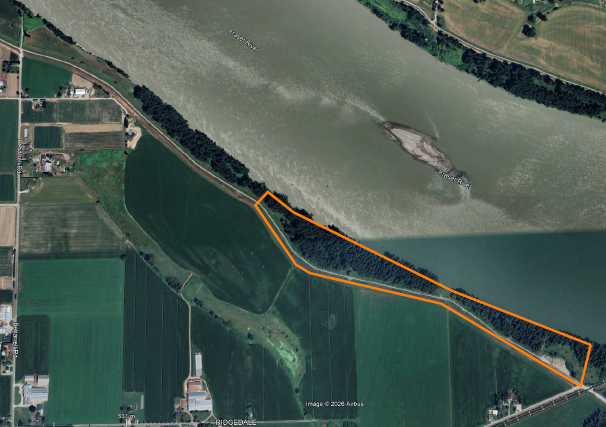
Drilling activity will take place in the outlined area.
Ask a Question
To ask a question you must create an account or log in.
These are the people that are listening and responding to your questions.
The Project Team
{{question.description}}